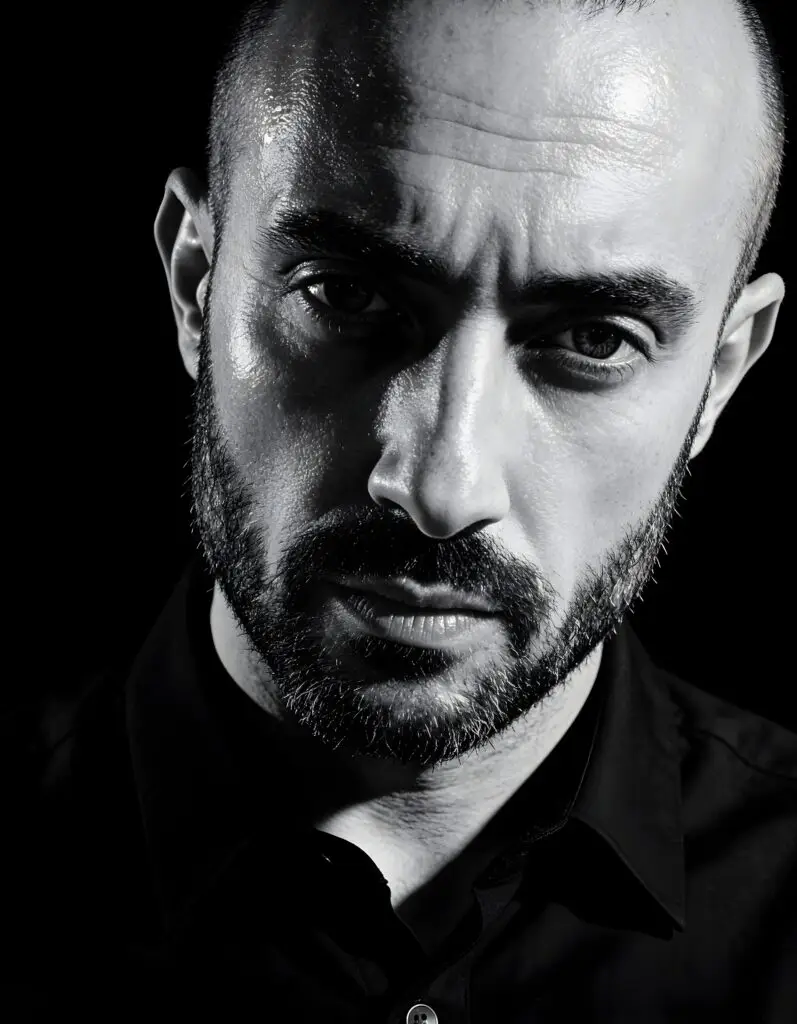
THE HUMAN
Structural author
Humanist thinker
Conceptual architect
Creator of universal systems
Identity of the author
Manuel Miralles‑Juan is a structural author and creator of universal systems. His work emerges from a deep sensitivity and an inner architecture refined through decades of study, experience, and human reorganization.
His thinking unfolds from a clear axis: truth as architecture, structure as language, and the cosmos as the exteriority of the human being.
Territorial root
ORIGIN was born in the land that sustains the author: Monforte del Cid, Novelda, and Alicante.
This territorial bond is not symbolic; it is structural. The cave‑sanctuary of San Pascual in Orito forms part of his vital and conceptual axis, one of the places where his sensitivity expanded and his work found clarity.
Conceptual work
He is the creator of ORIGIN, a conceptual system that articulates the relationship between:
the individual,
the world,
and the cosmos.
ORIGIN integrates form, movement, light, identity, and human expansion. It is not presented as a theory or a school of thought: it is a structural framework from which the author thinks, writes, and builds, without exposing its internal architecture on the web.
Human origin of the work
The work arises from an extreme human experience that reorganized his perception and amplified his sensitivity. At that vital threshold —between falling and continuing— the space opened from which ORIGIN took form.
The author recounts this process in The Square, the biographical work that precedes the system.
Biographical works
His work includes pieces that articulate the relationship between life and structure:
Both form the experiential root from which his thinking unfolds.
Professional trajectory
Between 2008 and 2024 he developed a distinguished career at University of Cambridge, holding senior positions in Spain, Portugal, and Southern Europe. His work in the international educational and editorial sphere consolidated the methodological and structural foundation from which ORIGIN would later be built.
International background and identity
He has developed formative and professional stages in:
London,
Washington,
New York.
He has studied at:
The Open University,
New York University.
His international experience expanded his structural vision and his reading of the human being in relation to the world and the cosmos.
Believe Square
Miralles‑Juan leads Believe Square, a creative, cultural, and educational ecosystem conceived as a meeting space for talent, community, and structural thinking.
Vision and purpose
His work is conceived with a vocation for permanence. It does not seek to impose itself; it seeks to deserve to be taken seriously.
Its purpose is to offer a conceptual architecture that helps the human being understand:
In the human being, earth and sun touch.